2025-12-03
Oyster Shell Upcycling Initiative: From Waste to Cement, Building a Circular Economy Model
Great Eagle Group has been spearheading Hong Kong's first cross-sectoral oyster shell upcycling programme in collaboration with The Langham, Hong Kong, Eaton HK, and Green Island Cement Group. This pioneering project transforms discarded oyster shells into a sustainable alternative raw material for cement production, establishing a circular economy model that demonstrates the synergy between environmental responsibility and commercial innovation.
Oysters are a popular choice in Hong Kong, with imports reaching 3,300 tonnes in 2023. Historically, most shells ended up in landfills due to limited local processing capacity. Recognising this issue, Great Eagle Group explored the potential of upcycling waste shells, inspired by research indicating their high calcium carbonate content—91% of that found in limestone—makes them an ideal substitute in cement manufacturing.
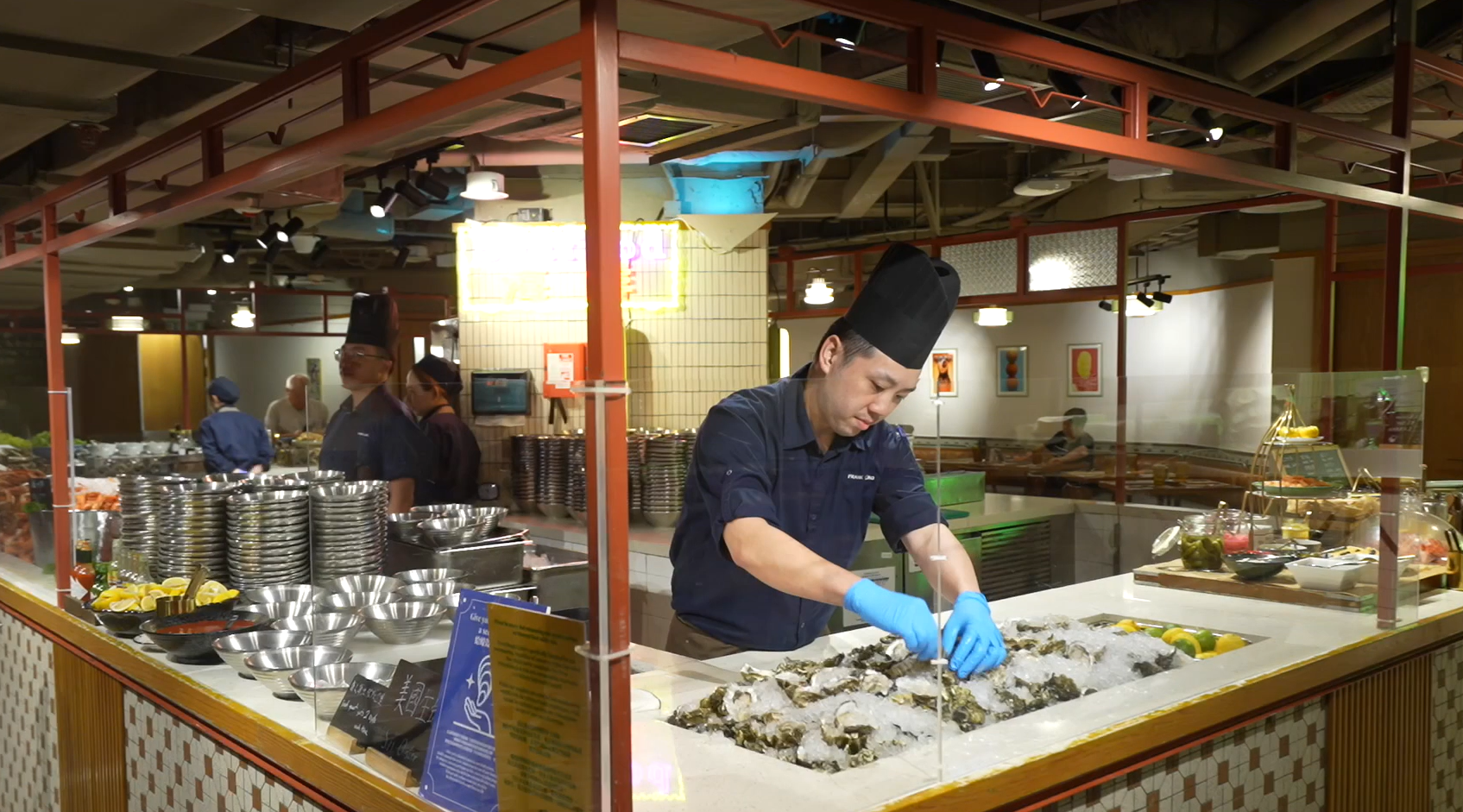
A pilot programme was launched in March 2023 at The Langham, Hong Kong and Eaton HK to test the feasibility of the collection, cleaning, storage, and transportation logistics. The initiative employs a “whole-community” approach: dedicated collection plates are placed at oyster counters in hotel buffets, encouraging customers to separate shells from other food waste. Hotel staff members then clean and sort the shells for collection by Green Island Cement.
To date, the project has successfully diverted approximately 43 tonnes of waste oyster shells from landfills (over 18 tonnes from the Group's hotels). If scaled up to handle all shells imported in 2023, it could potentially reduce emissions by 1,750 tonnes annually. The project’s success has inspired 16 other hotels and catering businesses to join similar efforts.
The team overcame challenges such as limited storage space and hygiene management by implementing rigorous quality control procedures and optimising logistics. Looking ahead, Great Eagle Group aims to promote the initiative further, encouraging broader industry participation. It has also recently expanded the programme to Langham Place Mall and will continue to extend to other shellfish, such as scallops and mussels, while collaborating with universities to research applications in ecological restoration and 3D printing.
At its heart, this initiative demonstrates that real progress happens when innovation meets execution—building practical, scalable pathways for diverse stakeholders to co-create measurable circularity solutions for Hong Kong.
Oysters are a popular choice in Hong Kong, with imports reaching 3,300 tonnes in 2023. Historically, most shells ended up in landfills due to limited local processing capacity. Recognising this issue, Great Eagle Group explored the potential of upcycling waste shells, inspired by research indicating their high calcium carbonate content—91% of that found in limestone—makes them an ideal substitute in cement manufacturing.
A pilot programme was launched in March 2023 at The Langham, Hong Kong and Eaton HK to test the feasibility of the collection, cleaning, storage, and transportation logistics. The initiative employs a “whole-community” approach: dedicated collection plates are placed at oyster counters in hotel buffets, encouraging customers to separate shells from other food waste. Hotel staff members then clean and sort the shells for collection by Green Island Cement.
To date, the project has successfully diverted approximately 43 tonnes of waste oyster shells from landfills (over 18 tonnes from the Group's hotels). If scaled up to handle all shells imported in 2023, it could potentially reduce emissions by 1,750 tonnes annually. The project’s success has inspired 16 other hotels and catering businesses to join similar efforts.
The team overcame challenges such as limited storage space and hygiene management by implementing rigorous quality control procedures and optimising logistics. Looking ahead, Great Eagle Group aims to promote the initiative further, encouraging broader industry participation. It has also recently expanded the programme to Langham Place Mall and will continue to extend to other shellfish, such as scallops and mussels, while collaborating with universities to research applications in ecological restoration and 3D printing.
At its heart, this initiative demonstrates that real progress happens when innovation meets execution—building practical, scalable pathways for diverse stakeholders to co-create measurable circularity solutions for Hong Kong.